









Why a coin flip beats a good trader at Apex (and almost nowhere else)
There’s a trick most futures prop traders have heard of, and plenty have tried. Buy a few cheap evaluations in a sale, then don’t really trade them. Put on one big trade with the stop at the drawdown floor and the target at the profit target, and let the market decide. Some of them pass. I’ve passed three out of five this way more than once.
Is that smart, or just lucky? We ran it through the same simulation we use to rank every firm, against a good trader who trades the evaluation properly. The short answer: at most firms the good trader wins easily. At two firms, the coin flip wins, and the reason isn’t the drawdown or the price. It’s the clock.
The odds of one trade
If a trade has no edge, the price is as likely to go up as down. Put the stop at the floor and the target at the profit target, and the chance of hitting the target first is:
drawdown ÷ (drawdown + target)
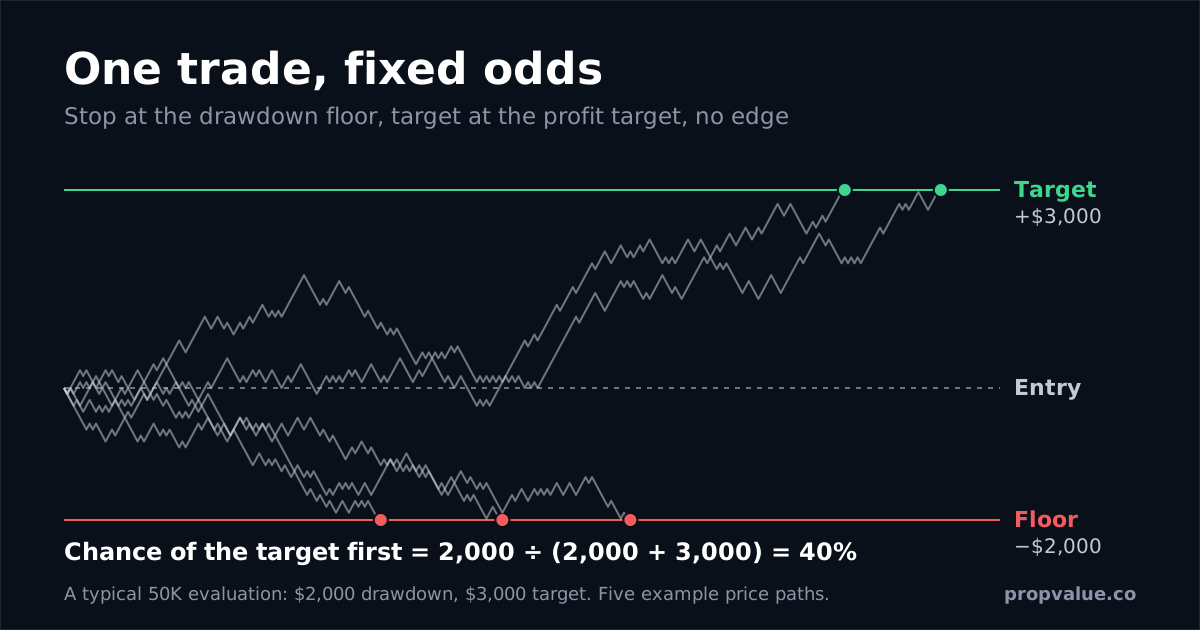
On a typical 50K evaluation, with a $2,000 drawdown and a $3,000 target, that’s 2,000 ÷ 5,000 = 40%. Bulenox’s 50K gives you $2,500 of room against the same target, so its odds are about 45%.
Two details matter:
- A daily loss limit doesn’t change the odds. If the limit is $1,000, your stop can only be $1,000 away, so you go again the next day with what’s left. It takes a few days instead of one, but the chance of passing is the same.
- An intraday trailing drawdown does change them. There the floor follows your open profit while the trade works, so a trade that runs $1,500 in your favor and comes back can fail you without ever going red. The odds fall to roughly one in four. That’s why our toggle leaves intraday accounts out.
So does it work? It depends entirely on what the alternative is.
Against a good trader
Our example traders all have a Sharpe ratio of 2.0, which means a real, solid edge. Here’s what the momentum trader gets by trading each evaluation normally, against passing with one trade, at every 50K account where one trade can pass. Each account’s funded phase is traded the same way in both columns. Only the evaluation changes.
| 50K account | Price | Trading it: pass / EV | One trade: pass / EV |
|---|---|---|---|
| Lucid Trading LucidPro | $120 | 50% / +$655 | 40% / +$532 |
| MyFundedFutures Builder | $77 | 50% / +$641 | 40% / +$510 |
| FundedNext Rapid Daily | $190 | 50% / +$494 | 40% / +$372 |
| Tradeify Growth | $145 | 48% / +$411 | 40% / +$337 |
| FundedNext Rapid Pro | $175 | 50% / +$337 | 40% / +$245 |
| Apex EOD | $59 + $129 activation | 35% / +$435 | 40% / +$510 |
| Bulenox Option 2 (EOD) | $44 + $148 activation | 36% / +$332 | 46% / +$431 |
EV is what one evaluation purchase is worth on average after every fee. At five of the seven accounts, a good trader passes half the time by trading, and flipping a coin throws money away. At Apex and Bulenox it’s the other way round: the coin flip passes more often than the good trader and is worth more.
That’s odd. Apex’s 50K has exactly the same target, drawdown and daily loss limit as MyFundedFutures Builder. So why does the same trader pass 50% of the time at one and 35% at the other?
It’s the clock
Both Apex and Bulenox give you 30 days. Apex calls its EOD evaluation “a 30-day assessment”, and Bulenox’s accounts show “Access valid for 30 days”. The other five accounts have no time limit.
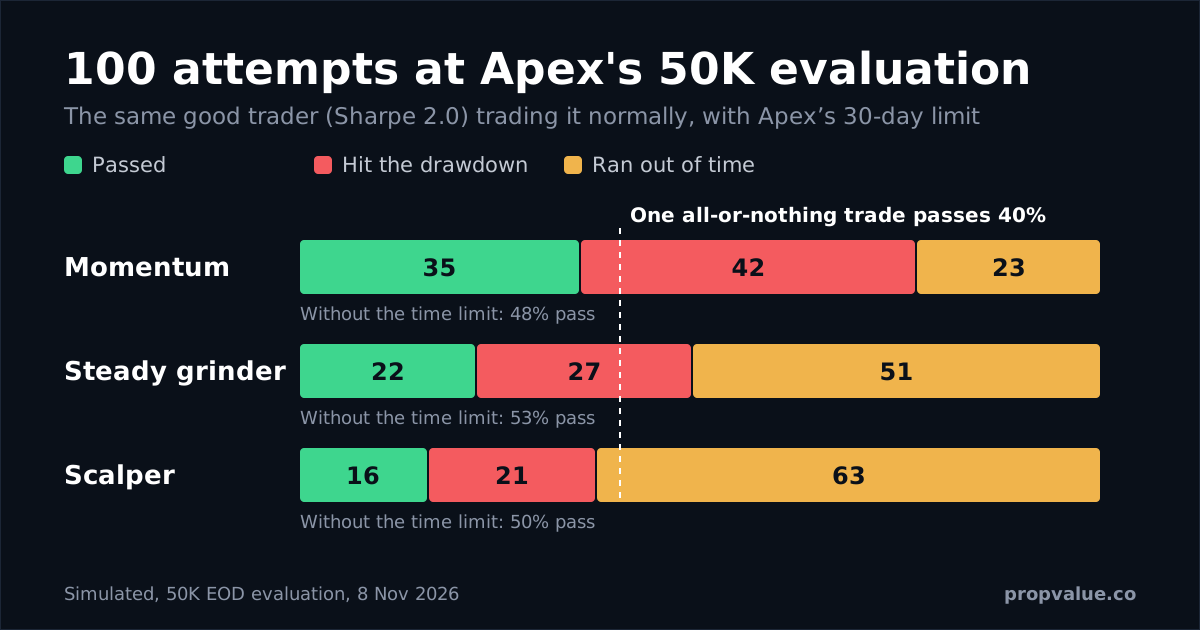
Thirty calendar days is about 21 trading days. A trader making a steady few hundred dollars a day needs most of that just to reach a $3,000 target, and one bad week is enough to run out of time. In our simulation, that’s where most failed attempts at these two firms go: not to the drawdown, but to the calendar.
| 50K, by strategy | Trading it: pass | Ran out of time | Same rules, no time limit | One trade: pass |
|---|---|---|---|---|
| Apex EOD, momentum | 35% | 23% | 48% | 40% |
| Apex EOD, steady grinder | 22% | 51% | 53% | 40% |
| Apex EOD, scalper | 16% | 63% | 50% | 40% |
| Bulenox EOD, momentum | 36% | 36% | 58% | 46% |
| Bulenox EOD, steady grinder | 22% | 64% | 61% | 46% |
| Bulenox EOD, scalper | 16% | 74% | 56% | 46% |
Take the time limit away and both firms pass good traders as often as anyone else, or more. Keep it, and a slow, steady strategy fails most attempts without ever breaking a rule. A one-trade pass takes a day or two, so the clock never comes into it.
This is also why the cheap price is a little misleading. A $59 evaluation that a steady trader passes 22% of the time costs about $270 per funded account, before the activation fee. The price on the checkout page doesn’t tell you that.
What to take from it
- If your strategy is slow, a 30-day limit costs you more than the sale saves. Grinders and scalpers are hit hardest. Compare accounts on expected value, not on the price.
- The funded account is where the money is. Apex’s funded side is decent: once funded, our momentum trader takes home about $1,540 on average over three months. Pick the firm for its funded terms first, then decide how to get through the evaluation.
- If you play the one-trade game, play it where it can work. That means an end-of-day drawdown, no evaluation consistency rule (Topstep’s, for example, means one trade can’t pass you), and enough contracts to make the target in one move. Apex’s 50K allows six minis, which is plenty.
- Read the rules first. Several firms, including Apex and Bulenox, have clauses against gambling-style trading. They mostly aim them at funded accounts, but check before you rely on it.
Try it with your own numbers
The value finder has a new option: Pass evaluations with one all-or-nothing trade. Tick it and every eligible account is ranked as if you passed it by luck and then traded your own strategy once funded. Untick it to see how your real trading compares. Accounts where one trade can’t pass are listed with the reason.
It’s still luck. Expect streaks in both directions, and treat the averages as averages. But if you’re going to buy a stack of cheap evaluations anyway, it helps to know where the odds are on your side.
Figures from our simulation on 8 November 2026, 50K accounts, using each firm’s current deal price. Rules and prices change; check the firm’s own site before you buy.
David J Kaplan is a computational scientist and futures trader who trades funded accounts with Apex and Tradeify.