









EOD vs intraday trailing drawdowns: which one fails you sooner
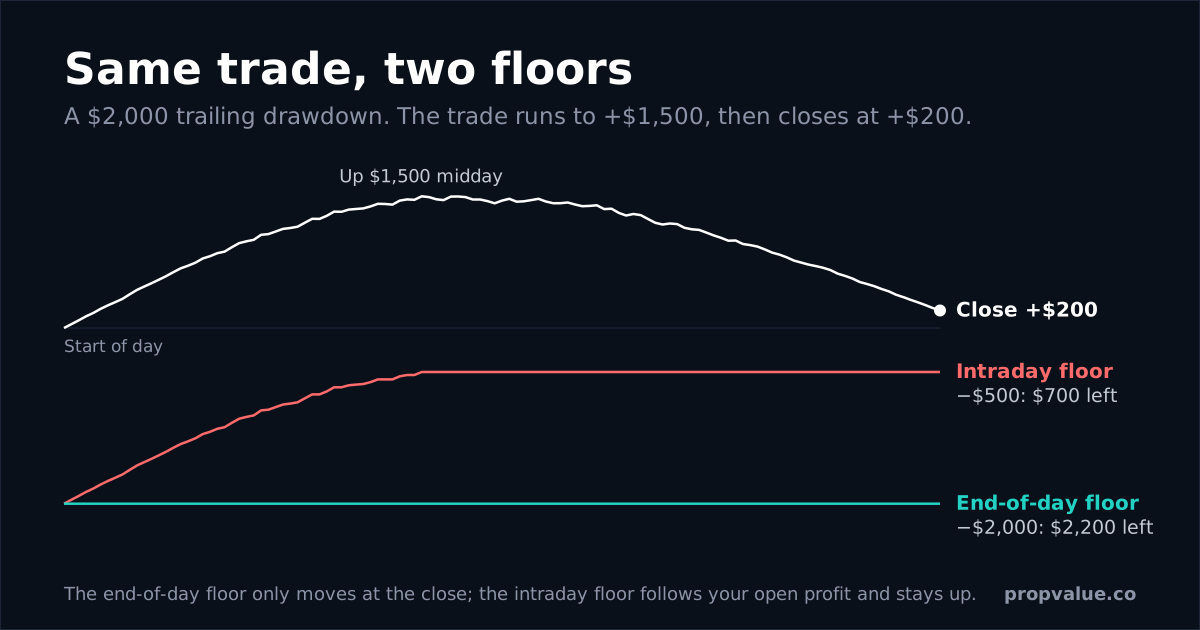
Most 50K futures evaluations let you lose $2,000 before blowing the account. The headline number tends to be the same across firms, but the loss floor can move differently with your gains and losses. How this floor moves can sway the outcome of an evaluation more than the profit target itself.
The floor follows your high
A trailing drawdown is a floor that sits $2,000 below your highest balance. If you make $500, the floor rises $500. If you lose $500, the floor stays where it is. Once the floor reaches a set level, often your starting balance (or $100 above it), it locks and stops moving.
The question is what counts as your “highest balance”.
End-of-day trailing
The floor updates once, after the session closes, from your closing balance. It doesn’t move during the day.
If you’re $400 green and the trade then goes against you and closes at breakeven, the floor stays where it was at the start of the day. Only realized, end-of-day progress moves it.
Intraday trailing
The floor follows your highest balance at any moment, including when you have unrealized profits from open positions. That same $400 trade drags the floor up $400 and leaves it there, even if the trade then goes against you and closes at breakeven.
Do that a few times in a session and you can lose a large part of your cushion without a single losing trade.
Who feels the difference
- Traders who let winners breathe. Every pullback from an open high costs cushion on an intraday account.
- Scalpers who often go green before stopping out. Each round trip ratchets the floor higher behind you.
- Home-run styles. Big open swings in your favor raise the floor sharply before you bank anything.
Traders who take profit quickly and rarely see open profit reverse feel little difference.
See it on your own numbers
The drawdown calculator plots one set of trades against both floors, so you can see where the intraday version breaches and the end-of-day one survives. The value finder runs your own win rate and trade sizes through every firm’s rules, including how often your losing trades are in profit before they turn.
How to choose
If your trades often show open profit before they close at a loss, end-of-day drawdowns will tend to serve you better, even if they cost more. If you take quick, small profits and cut losers fast, an intraday account can be the cheaper way in.
Check the funded account as well as the evaluation. Some firms use end-of-day trailing to pass and intraday trailing once you are funded, which is when it costs real money. If you get used to end-of-day trailing during the evaluation, the intraday trail can catch you by surprise.
David J Kaplan is a computational scientist and futures trader who trades funded accounts with Apex and Tradeify.